
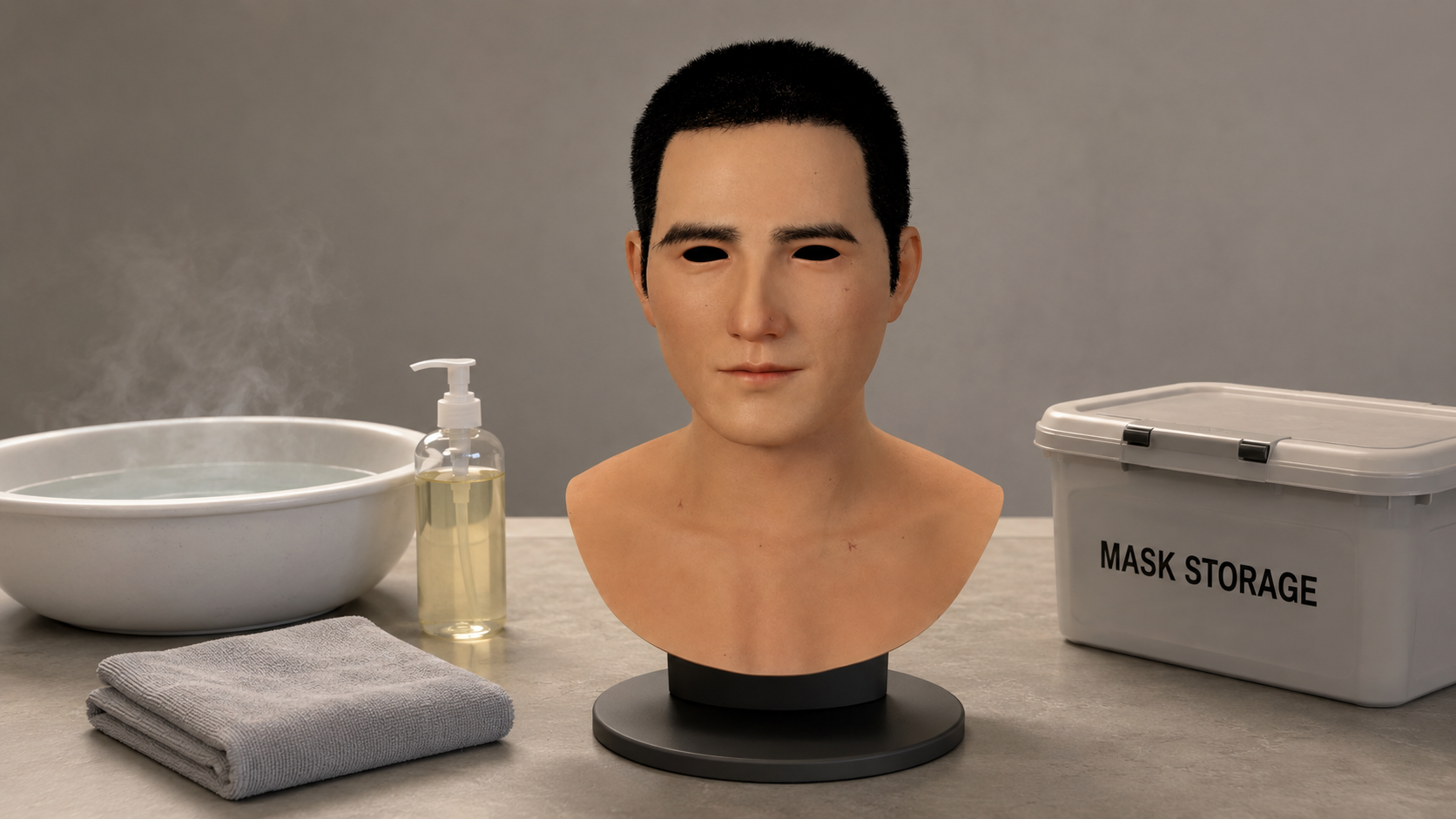
An ultra realistic silicone mask is a detailed wearable prop. Its flexible silicone, hand-painted skin texture, thin openings and optional implanted hair all require careful handling.
Whether the mask is used for film production, cosplay, haunted attractions, stage performance, special effects or private collection, a simple cleaning and storage routine can help preserve its appearance and reduce avoidable damage.
Basic Silicone Mask Care Routine
- Remove the mask carefully.
- Clean the interior and exterior gently.
- Avoid scrubbing painted or hair-punched areas.
- Allow the mask to dry completely.
- Inspect thin and frequently handled areas.
- Store it away from heat, sunlight and sharp objects.
Premium Realism Deserves a Care Routine
An ultra realistic silicone mask combines a flexible cast with detailed paint, sculpted skin texture and sometimes hand-finished hair, eyebrows, eyelashes or beard work.
Silicone is a stable material, and a quality mask can remain usable for a long time with normal use and proper care. However, the mask is not indestructible.
Areas that require extra care include:
- The painted exterior coating
- Eye openings
- Mouth opening and lips
- Ears
- Jawline and chin
- Neck opening and bib
- Implanted hair and hairline
- Eyebrows, eyelashes and beard
These areas may be thinner, highly detailed or repeatedly handled. Cleaning gently after use and storing the mask correctly can reduce unnecessary wear.
You can browse ultra realistic silicone masks to compare different full-head designs and finishes.
Remove the Mask Carefully
Proper care begins before cleaning. Removing the mask incorrectly can place unnecessary stress on the silicone.
When removing a full head silicone mask:
- Place your hands inside the mask rather than pulling the exterior.
- Support the mask around the inner cheek and head areas.
- Stretch it gently outward to create space.
- Guide the mask upward and away from the head slowly.
- Keep supporting the silicone until it is completely removed.
Do Not Pull These Areas
- Neck bib
- Jawline or chin
- Mouth or lips
- Eye openings
- Ears
- Hair, beard or eyebrows
These detailed areas should not carry the force of removing the mask. Supporting the silicone from inside helps distribute pressure more safely.
Clean the Mask Gently After Use
Choose a Mild Cleaning Method
Select the lightest cleaning method suitable for the residue on the mask. Routine cleaning should focus on areas that contact the wearer’s forehead, cheeks, chin, scalp and neck.
FeiLang’s current care guidance includes:
- Gentle baby wipes
- Isopropyl alcohol spray used carefully with a paper towel
- Warm water with mild dish soap
Check Before Using a New Cleaner
Paint and hair finishes can vary between mask designs. Before applying alcohol, wipes or another cleaning product to a valuable or custom mask, ask FeiLang whether it is suitable for that exact finish.
Method 1: Warm Water and Mild Soap
Warm water and mild dish soap are suitable for general cleaning when used carefully.
- Prepare warm water—not hot water.
- Add a small amount of mild dish soap.
- Use a soft cloth or your hands to clean gently.
- Pay attention to the forehead, cheeks, chin and neck areas.
- Avoid rubbing hair-punched and heavily painted details.
- Rinse away the soap carefully.
- Allow the mask to dry completely before storage.
Method 2: Gentle Wipe Cleaning
A gentle wipe can be useful for light surface residue or small areas that do not require full washing.
- Confirm that the wipe is suitable for the mask’s finish.
- Test it on a small, less-visible area when appropriate.
- Wipe gently without repeated rubbing.
- Avoid implanted hair, eyelashes, eyebrows and beard.
- Allow the cleaned area to dry completely.
Method 3: Isopropyl Alcohol
Isopropyl alcohol may be used for certain cleaning situations, but it should be applied carefully. Repeated or aggressive use may affect some paint or surface finishes.
- Confirm the method with FeiLang for the specific mask.
- Use only a small amount.
- Apply it to a paper towel or soft material rather than soaking the mask.
- Wipe gently without scrubbing.
- Keep it away from implanted hair and delicate painted areas unless approved.
- Allow the area to dry completely.
Do Not Scrub the Painted Surface
Strong friction can damage or remove the outer coating that gives a hyper realistic silicone mask its finished skin appearance.
Avoid:
- Abrasive sponges or pads
- Hard brushes
- Aggressive repeated rubbing
- Sharp cleaning tools
- Unapproved chemical cleaners
- Bleach
- Strong solvents
- Very hot water
Protect Hair and Fine Details
Implanted hair, eyebrows, eyelashes and beard details require additional care. Avoid rubbing across these areas or pulling individual hairs.
When cleaning around hair details:
- Pat gently rather than rubbing
- Follow the direction of the hair
- Do not pull knots aggressively
- Avoid soaking attached hair unless approved
- Keep strong cleaners away from the hairline
- Do not use sharp combs or tools against the silicone
For a valuable custom piece or a mask with extensive implanted hair, ask FeiLang’s custom mask team which cleaning method is best for the exact paint and hair finish.
Let the Mask Dry Before Storage
Check the Interior and Exterior
After cleaning, make sure moisture is not trapped inside the full head silicone mask. Allow it to dry at room temperature in a clean, protected area.
Check for moisture around:
- The interior forehead
- Cheek folds
- Eye openings
- Mouth and chin areas
- Inside the ears
- Neck folds
- Hairline and beard areas
Do Not Use Direct Heat
Do not use a hair dryer, heater, hot air gun or other high-temperature device to speed up drying. Keep the mask away from excessive heat and direct sunlight.
Complete a Quick Inspection
Before storing the mask, inspect frequently handled and thinner areas. Finding a small issue early gives the owner or prop team time to request repair guidance before the next event or shoot.
Inspect the:
- Eye openings
- Mouth and lips
- Chin and jawline
- Ears
- Neck edge and bib
- Hairline
- Eyebrows and beard
- Painted surface
Repair Small Splits Carefully
FeiLang’s FAQ recommends Sil-Poxy adhesive by Smooth-On for certain small silicone splits or cuts. However, the correct repair method depends on the damage location, depth, paint finish and surrounding details.
Contact FeiLang before attempting a repair when the damage affects:
- A highly visible painted area
- An eye or mouth opening
- Implanted hair or beard
- The neck edge
- A large or structural section
- An area that continues to tear
Do not use ordinary household glue unless FeiLang confirms that it is suitable. Many common adhesives will not bond correctly to silicone and may damage the visible finish.
Review the FeiLang mask care and repair FAQ for additional guidance.
Store the Mask Without Distortion
Option 1: Use a Smooth Support Stand
A smooth stand can support the mask for display or short-term storage. The stand should support the shape without stretching the silicone.
A suitable stand should:
- Have a smooth surface
- Contain no sharp edges
- Support the mask without stretching it
- Avoid pressure on the nose, ears or jaw
- Allow the neck section to rest naturally
- Remain stable and unlikely to fall
Do not place the mask on an oversized head form that keeps the silicone stretched during storage.
Option 2: Store the Mask Flat
FeiLang also states that a mask may be stored flat in a clean plastic bag at room temperature.
For flat storage:
- Confirm the mask is completely dry
- Use a clean bag or storage container
- Arrange the face and neck naturally
- Avoid sharp folds
- Do not place heavy items on top
- Keep wardrobe hardware away from the surface
- Give implanted hair enough space
Control the Storage Environment
Store the mask in a clean indoor environment away from:
- Direct sunlight
- Windows with strong UV exposure
- Heaters and hot equipment
- Hot vehicles
- Sharp props or tools
- Heavy equipment cases
- Makeup tools with exposed metal edges
- Crowded storage areas
- Dust, dirt and uncontrolled moisture
A clean room-temperature location is better than a hot vehicle, exposed window or crowded production equipment case.
| Storage Factor | Recommended | Avoid |
|---|---|---|
| Temperature | Normal indoor room temperature | Heaters, hot cars and direct heat |
| Light | Protected indoor storage | Direct sunlight and exposed windows |
| Support | Smooth stand or relaxed flat storage | Oversized stands and sharp pressure points |
| Pressure | Enough space around the mask | Heavy props or cases placed on top |
| Condition | Completely clean and dry | Storing while damp or dirty |
Care for the Mask During International Travel
If the mask will travel between countries or production locations, retain suitable protective packaging whenever possible.
Before packing:
- Clean and dry the mask completely
- Arrange the face and neck naturally
- Protect hair and beard details
- Prevent pressure on the nose, ears and jaw
- Keep sharp wardrobe accessories separate
- Use a clean protective container
- Label the container for the prop team
After delivery, unpack and inspect the mask before the production date. Customs and courier timelines can vary, so allow enough time for unpacking, inspection, fitting and camera testing.
Review FeiLang’s worldwide shipping information before ordering.
Build Care Into the Production Workflow
Assign One Prop Handler
For repeated shooting days, choose one trained team member to manage wearing, removal, cleaning, inspection and storage.
Consistent handling reduces the chance that an unfamiliar team member pulls on the neck bib, jaw, mouth, hair or another delicate area.
The assigned handler should manage:
- Pre-use inspection
- Correct wearing technique
- Performer fit checks
- Careful removal
- Cleaning and drying
- Post-use inspection
- Storage and transport
- Repair communication when required
Keep a Simple Care Log
A short care log is useful for a frequently used film production or movie prop mask.
Record:
- Date of use
- Performer name
- Approximate wearing time
- Cleaning method used
- Inspection results
- Any new damage or wear
- Repair work completed
- Storage location
This is especially useful when the same character returns across multiple production days.
Confirm Care Before Purchase
Live video verification is not only useful for checking realism. During a WhatsApp call, buyers can ask FeiLang to show the actual product, inside construction, detailed finish and correct handling method.
During the call, ask about:
- The best cleaning method for the exact mask
- Care for its paint finish
- Care for implanted hair or beard
- Correct wearing and removal technique
- Recommended storage position
- Suitable stand size
- Repair guidance
- Stock or made-to-order status
- Worldwide shipping to your destination
Seeing the actual mask and receiving direct guidance helps a film or special effects team prepare the correct stand, cleaning supplies, storage space and handling plan before the prop arrives.
Need Care Guidance for a Specific Mask?
Contact FeiLang to see the exact silicone mask by live video and confirm its cleaning, handling, storage and worldwide shipping before ordering.
Ask FeiLang on WhatsAppFinal Care Checklist
After every use:
- Remove the mask by supporting it from inside
- Clean it using a suitable gentle method
- Do not scrub the painted surface
- Protect hair, eyebrows, eyelashes and beard
- Allow the interior and exterior to dry completely
- Inspect the eyes, mouth, ears, jaw and neck
- Ask for guidance before attempting a difficult repair
- Use a smooth stand or relaxed flat storage
- Keep the mask away from sunlight and heat
- Prevent sharp or heavy objects from touching it
Buyers can also review real customer orders and feedback before choosing a mask.
Protect Your Silicone Mask
Explore FeiLang’s realistic silicone masks or request live care guidance for the exact design before placing your order.
Shop Silicone Masks Request Live Guidance